Scarf Styling for Women Over 50 That Goes Beyond the Standard Neck Knot
Every one of us owns the same scarf habit. The big loop around the neck, a half-hearted knot, and out the door. It keeps you warm, and there is nothing wrong with it, but it is also the reason a drawer full of scarves never quite does anything interesting for an outfit. The scarf is not the problem. The default is.
Once you stop treating the scarf as a neck-only accessory, it becomes the hardest-working thing in your closet. It can stand in for jewelry, sharpen a plain coat, rescue a bad hair day, and turn an outfit you have worn ten times into something that looks intentional. Scarf styling for women over 50 that goes beyond the standard neck knot is really about seeing the whole piece of fabric, not just the part that sits on your neck.
You do not need new scarves for this. The ones in your drawer — the silk square from a trip, the pashmina that only comes out in December, the chunky knit from three winters ago — are all candidates. What follows pairs each scarf type with one specific styling move, and most of them slot right into your existing fall outfits for women over 50.
Why the Scarf Is Doing More Work Than You Think
The women who style scarves best tend to think in shapes rather than knots. Sixty and Me, in their guide to tying a scarf like a pro, suggests starting with geometry: look to a man’s tie for shape, drape one end over a shoulder, and above all follow the “fluff and fold” rule — shape the ends of a large scarf instead of leaving them flat, because flat ends are what make a scarf look tired.
The same piece points out that a scarf can quietly replace a necklace: a ruffle-edged silk square, or a square folded to a triangle and draped with the point down the chest like a bib, does the job of jewelry without a clasp in sight. And a cozy knit scarf earns its place twice over, camouflaging the neck area while keeping you warm — two problems, one accessory.

The other half of the craft is restraint. SHOPBAM’s style notes on wearing a scarf without looking overstyled make the case for matching the scarf’s weight to the outfit’s weight: fine silk with shirts and tailored jackets, chunky wool with coats and boots.
Their simplest move is the drape — both ends falling in front, one side slightly longer, no knot at all — and they are equally fond of wearing the scarf beyond the neck entirely: tied on a handbag handle, threaded through belt loops, wrapped around a low ponytail.
Their closing rule is worth taping to the mirror: before leaving, remove one competing accessory. A scarf doing interesting work does not need a statement necklace, bold earrings, and a brooch standing next to it.
Taken together, the advice from both sources points in the same direction. Stop tying the default knot, match the scarf to the outfit’s weight, give the ends some shape, and let the scarf replace something else in the outfit rather than piling on top of everything. That is the whole philosophy behind the twelve formulas below.
1. The Oversized Wool Wrap (Shoulder-Spread Drape, No Knot)

The oversized wool wrap is the closest thing to a blanket that still counts as getting dressed, and the shoulder-spread drape treats it like one. You open the whole thing out and lay it across your shoulders like a shawl, letting it fall evenly down both sides of the body.
It flatters a woman over 50 because it skims everything — the drape creates a long, unbroken line from shoulder to hem, which softens the middle without a belt, a tuck, or any fuss. The detail that matters is width: you want a wrap at least 28 inches wide, or the spread collapses into a sad narrow strip.
Wear it over a long-sleeve tee and straight-leg trousers with one long end left to fall down the front. The same move upgrades an all-black winter outfit — black turtleneck, black trousers, black boots — where the oatmeal or camel wrap becomes the only texture in the outfit and carries it.
2. The Silk Square (Necklace Fold, Replaces Jewelry)

The necklace fold is for the woman who never wears necklaces anymore but misses what they did for a neckline. You fold the square diagonally into a narrow band, wrap it once around the neck so the ends sit at the side of the neck, and tie a small flat knot behind.
It flatters because it puts color and pattern exactly where jewelry used to sit — that V of the throat above a scoop or boat neckline — drawing the eye up to the face instead of leaving the neckline empty. The detail that matters is scale: a 36-inch square makes a delicate band, a 42-inch makes a fuller one, and neither works folded too tight.
Style it over a plain cashmere crewneck with the silk ends tucked behind the knot for a clean band of pattern. It travels well beyond the office: the same fold dresses up a simple black shift dress for dinner, doing the work a pendant would do without touching your jewelry box.
3. The Cashmere Pashmina (Asymmetric Once-Around, Ends Different Lengths)

The once-around is the move most women already do, and the asymmetric version is the one correction that makes it look deliberate. You wrap the pashmina once around the neck, then pull it until one end hangs a good six inches longer than the other and let both ends fall without touching them. It flatters because the asymmetry creates a diagonal line across the torso, which breaks up the horizontal stacking that makes a standard loop look bulky. The detail that matters is not tucking the ends in — the moment you tuck them, it is back to being a knot-adjacent default.
Wear it over a wool coat with the long end on the outside, so the color runs down the front of the coat. When you take the coat off indoors, the same drape works over a fitted knit dress, where the softness of the cashmere reads as evening-appropriate without any effort.
4. The Chunky Knit Scarf (Fluffed Ends, Geometry Like a Tie)

The chunky knit scarf only looks heavy when its ends lie flat and dead. The fix is to treat it like a man’s tie: drape one end a little longer, angle it across the body, and fluff each end so it has volume instead of lying limp. It flatters because the bulk sits off-center, which keeps the neck and face visible instead of buried — the difference between cozy and swallowed. The detail that matters is the fluff: spread the knit open with your fingers after draping, the way you would shake out a curtain, and it doubles in visual interest.
Style it with a parka and jeans, letting the angled long end break up the straight lines of the coat. It works just as well with a puffer vest over a sweater, where the chunky texture echoes the vest and the whole outfit looks thought through rather than thrown on.
5. The Lightweight Wool Rectangle (Simple Drape, One Side Longer)

The simple drape is the most underrated move in this list because it is barely a technique at all: the scarf hangs around the neck, both ends fall in front, one side sits slightly longer, and nothing is tied. It flatters because the vertical lines of the ends draw the eye straight down, lengthening the torso the way an open jacket does. The detail that matters is weight — a lightweight wool rectangle has enough body to hang in clean lines but not so much that it puffs, which is exactly why it works and a gauzy scarf collapses here.
Wear it with a tailored blazer and trousers, letting the ends fall inside the open jacket line. The same drape carries a trench coat in spring and fall, where the wool rectangle adds just enough warmth for the walk while the long lines keep the outfit sharp.
6. The Silk Twilly (Handbag-Handle Tie)
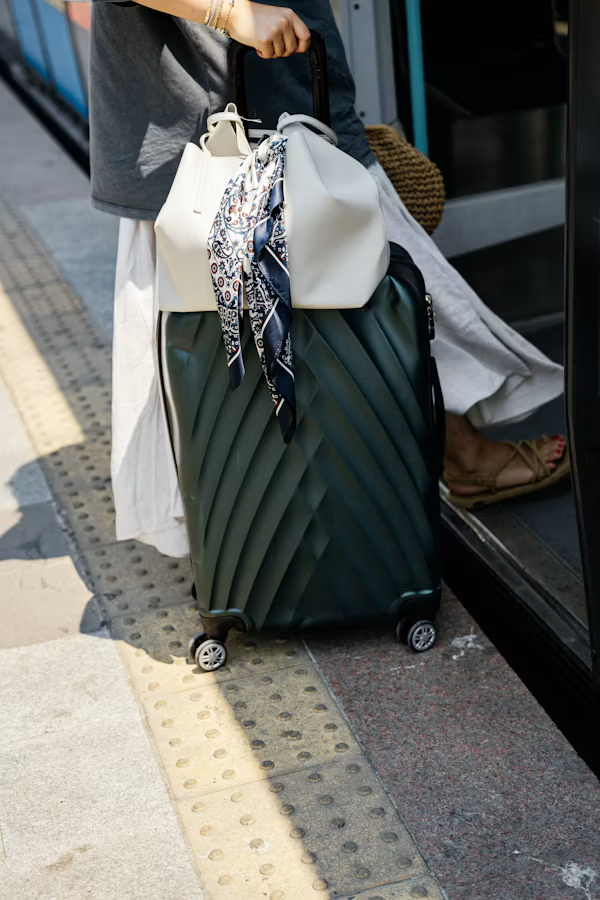
The twilly — that narrow silk ribbon originally made for handbag handles — is the scarf that never touches your body, which is precisely its charm. You wrap it around the base of one handle and tie it in a loose bow or let the ends trail, and suddenly a plain structured bag has a point of view.
It flatters indirectly: it keeps your outfit’s color story going past the waistline without adding anything to the body itself, which is useful when the scarf is patterned and you want it in the outfit but not on you. The detail that matters is placement: wrap it at the base of the handle where it meets the bag, not the middle, so it stays put.
Tie it on a tan leather tote with jeans and a blazer for a weekend outfit that looks considered. It also dresses up a black evening clutch-adjacent crossbody, where a jewel-toned twilly does what a brooch would do — but on the bag instead of the lapel.
7. The Blanket Scarf (Belted as a Waist Sash Over a Coat)
Belting a blanket scarf over a coat turns the scarf into outerwear architecture. You drape the unfolded scarf across your shoulders and down your back and front, then run a slim leather belt over the whole thing at the natural waist. It flatters because the belt creates a waist on top of a boxy coat, and the scarf adds a layer of pattern and color that reads intentional rather than bulky. The detail that matters is the belt: keep it slim and structured, since a wide or slouchy belt fights the scarf’s fabric instead of anchoring it.
Style it over a plain camel or charcoal coat with dark jeans and boots, letting the plaid do the talking. When the coat comes off, the same belted move works over a long cardigan for dinner at a friend’s house — the coat trick, minus the coat.
8. The Printed Crepe Rectangle (Threaded Through Coat Belt Loops)
Threading a scarf through the belt loops of a coat is the kind of move that makes strangers ask where you learned it. You weave the narrow rectangle through the loops the way a belt would go, let the ends hang at the side or front, and skip the coat’s actual belt. It flatters because it defines the waist with pattern instead of a dark leather strap, so the whole middle of the outfit stays light and interesting. The detail that matters is the fabric: a printed crepe or fine silk has the right weight to thread and drape, while a thick wool fights the loops and bunches.
Wear it on a trench or belted wool coat in place of the matching belt, with the print pulling one color from the rest of the outfit. It also works on a robe-style coat that has no belt at all, where the scarf becomes the closure and the decoration in one move.
9. The Ribbed Merino Snood (Head-Wrap for Bad Hair Days)

The snood as a head-wrap is the most practical entry on this list: a tube of ribbed merino pulled up over the head and twisted once at the nape covers second-day hair completely while framing the face in soft knit. It flatters because the knit sits close to the head, which keeps the proportions small and clean, unlike a bulky wrapped scarf that can overwhelm the face. The detail that matters is the twist: one full twist at the back of the neck keeps the tube from riding up, and the ribbed texture holds its shape through the day.
Style it in charcoal or navy with a wool coat and sunglasses for a city-winter look that reads very European. It doubles as the neck warmer it was designed to be on truly cold days — pull it back down around the neck when you get indoors, where it behaves like a normal snood.
10. The Satin Neck Scarf (Wrapped Around a Low Ponytail)

Wrapping a small satin square around a low ponytail is the grown-up version of a scrunchie, and it is more flattering than it sounds. You fold the scarf into a band, wrap it over the hair tie, and knot it underneath so the ends trail a few inches down your back. It flatters because the satin catches light behind the head, which reads as polish from every angle, and a low ponytail keeps the whole thing calm rather than sporty. The detail that matters is covering the elastic completely — a visible hair tie under the scarf ruins the effect, so wrap twice and knot snug.
Wear it with a silk blouse and trousers for work, where the ponytail reads intentional and the scarf adds the jewelry element. The same move handles a casual weekend, too — a blush or leopard-print satin square turns a grey sweater and jeans ponytail into an actual style choice.
11. The Fringed Boho Wrap (Bib Drape: Square Folded to Triangle, Point on Chest)

The bib drape is the scarf’s answer to a statement necklace: fold a large square into a triangle, drape it with the point down the center of the chest, and let the fringe fall. It flatters because the triangle creates a strong vertical line right where a V-neckline would, drawing the eye down and lengthening the torso while the fringe adds movement. The detail that matters is the fold: press the triangle flat once before draping so it lies in a clean point instead of a wrinkled blob, and keep the back of the scarf high at the neck so the point lands mid-chest.
Style it over a plain black or navy crewneck sweater with jeans, where the rust or ochre print becomes the outfit’s entire personality. It also works over a simple jersey dress for an evening out, standing in for every piece of jewelry you would otherwise have debated.
12. The Infinity Loop Scarf (Doubled as a Wrist Wrap Over a Cuff)
Doubling an infinity loop around the wrist over a coat cuff is the oddball of the list, and that is what makes it worth trying. You twist the loop into a figure eight and slide your hand through, letting it sit snug over the sleeve like an oversized cuff. It flatters because it puts a soft, textural detail right at the wrist, where it frames the hands and breaks the straight line of a long coat sleeve. The detail that matters is the loop’s circumference: a loop that doubles to roughly wrist size sits comfortably, while a very large loop slides off and a very small one cuts in.
Style it over a navy wool coat with the navy loop creating a tonal cuff, letting it read as part of the coat’s design. It also works as a quick fix when sleeves run long — the doubled loop holds the extra fabric in place while looking like a deliberate styling choice.
Scarf styling for women over 50 that goes beyond the standard neck knot comes down to one habit change: before you tie the default, ask what else the scarf could do. Replace the necklace, sharpen the coat, frame the face, or hold the sleeve — the scarf in your drawer is already good enough, it just wants a different job.
Frequently Asked Questions
What is the easiest scarf styling trick for beginners?
The simple drape is the lowest-effort move that still looks different: hang a lightweight wool rectangle around your neck with both ends falling in front, one side slightly longer, and do not tie anything. It takes five seconds, creates lengthening vertical lines, and works over a blazer, a coat, or a plain sweater. Once that feels natural, the asymmetric once-around is the next step up.
How do you wear a scarf without looking overdressed?
Match the scarf’s weight to the outfit’s weight — fine silk with tailored pieces, chunky wool with coats and boots — and remove one competing accessory before you leave. A scarf worn as a handbag tie, a hair wrap, or a belt-loop accent reads as a detail rather than an event, which keeps the whole outfit grounded. The overdressed feeling usually comes from a scarf plus statement jewelry plus bold earrings, not from the scarf alone.
Can a scarf replace jewelry?
Yes, and it often does the job better. A silk square folded into a narrow band and tied at the side of the neck puts pattern exactly where a necklace would sit, and a large square folded into a triangle and draped bib-style down the chest acts as a statement piece. Choose prints that pick up a color in the outfit and keep the rest of the jewelry minimal so the scarf is the focus.
Which scarf fabric is most flattering for women over 50?
Cashmere and fine merino are the safest choices because they drape softly and never fight the body, while silk and satin add light-catching polish around the face. Chunky knits work well if you fluff the ends and keep the bulk off-center rather than piled at the neck. The least flattering option is usually a stiff or shiny polyester, which holds awkward shapes and reflects light in ways that emphasize rather than soften.


